Thursday, December 1, 2011

A County Compass Column by Judi Heit (April~December 2009)

ESSENCE OF GENEALOGY TO LINK GENERATIONS
Week of April 2-8, 2009

The creation of your family tree begins with YOU ... and grows one branch at a time.

As much as we might like to, we cannot look into the future. But we do have the luxury of looking back … of gathering information about those who came before us and recording what we learn.

The essence of genealogy involves the linking of generations, one to the next, with each generation set in the context of its own period in history. To learn about these people ... not just their names and dates ... but about their lives ... is the goal of family historians.

With this as an objective, where does a budding family genealogist begin?

Back in the old days, family researchers had to travel to libraries, squint at microfilm readers, write away for vital documents and wait patiently for their arrival ... often to learn records could not be found. Today, the internet gives us fast access to genealogical records and more, making research easy, fun and instantly gratifying!

One thing that hasn't changed is the format researchers use to collect information. Be it on paper or in a database, you begin with yourself and grow your tree one generation at a time. But first, you need a place to record what you've learned.

LESSON 1: FAMILY GROUP SHEETS

Each bit of information concerning an ancestor and his/her immediate family is recorded onto a Family Group Sheet. Since the end result of your research efforts will be to compile complete, correct and connected families, the use of family group sheets from the beginning will make the compilation much easier.

[For a FREE download of a Family Group Sheet, go to: www.familytreemagazine.com/upload/images/pdf/familygroup.pdf.]

1. Carefully record the important facts of your own life and what you know of your parents and grandparents. Write out FULL given names, including Americanized versions, "Nicknames" [i.e. Boleslawa “Pauline” M. Gadomski] and maiden names.

2. Regardless of the form you use, get into the habit of recording actual and approximate dates as DAY/MO/YEAR [i.e. 01 Jan 0000, abt. 01 Jan 0000, bet. 0000 - 0000 or ca. 0000]. Always write out the year in full.

3. Record what you know of the location in which an event happened. For ancestors born in the U.S.: Oriental, Pamlico Co., NC; Oriental, NC; Pamlico Co.; NC; or simply NC. For European ancestors, this can become a challenge … especially where boundaries were affected by a war.

Unless you know the correct spelling of a name or place, record what you know (or think you know). For example: Starts with …; Sounds like …; Is phonetically …; or Contains... More often than not, you will find ancestors by using variant spellings on their name. If you know of common misspellings, make a note of them.

4. To the extent it is possible, collect and record whatever information you can find on siblings. As you go further back in time, you will run into dead ends. More often than not, turning your attention to a sibling will uncover clues you can use to continue your search.

Perfect practice makes perfect: Take your time, write clearly, be consistent and proofread your work.

CREATION OF YOUR FAMILY TREE BEGINS WITH YOU
Week of May 7-13, 2009

In addition to providing leads to resources where you might find information about your ancestors, biographical data fills in the spaces between limbs and branches … creating the “foliage” that will add personal interest to your research.

So it’s time to visit with members of your family to review your family group sheets and collect information they know or have gathered: You may find they have saved family papers, newspaper clippings, obituaries, family bibles, old photographs and other treasures that will be valuable as you continue your climbing your tree.

Don’t forget to bring your camera and, if you have one, a tape recorder. When you borrow photographs and vital documents, treat them with utmost care … copy them carefully and return them quickly!

LESSON 2: COLLECTING BIOGRAPHICAL DATA

When interviewing parents, grandparents, aunts and uncles the best way to collect biographical data is to ask open-ended questions (rather than ones with yes or no answers). The answers to some of these questions will be valuable when in comes time to search immigration records and U.S. Censuses. Here are some sample questions:
  • What's your first memory about our family?
  • Who's the oldest relative you remember (and what do you remember about him or her)?
  • Where did your family live in (1910, 1920, 1930, 1940)? Tell me about your childhood home.
  • Who was the first member of your family to migrate to the U.S.? Where did they come from (try to get a good spelling of their place of origin)? When did they arrive? Who were they coming to?
  • Where did your parents meet? (If you don’t already know, ask when and where they married. Get maiden names also!)
  • How did you meet your spouse? Tell me about your wedding day. (Again, ask when and where if you don’t already know.)
  • If you served in the military, what branch? When were you discharged?
  • If you went to college, where did you go and when did you graduate?
  • Describe your first job.
  • What haven't we talked about that you'd like to discuss in the time we have left? (This is a good way to begin wrapping up the interview.)
[For a FREE download of a Biographical Outline Sheet and Oral History Interview Record, go to: www.familytreemagazine.com/upload/images/pdf/biographical.pdf and www.familytreemagazine.com/upload/images/pdf/oralhistory.pdf.]

Perfect practice makes perfect: Without actual proof of an event (birth/marriage/death certificates, obituaries, etc.), it’s important to note sources of the information you collect. There is nothing more frustrating than finding new data which conflicts with something you’ve already recorded and not being able to put your hands on the original source.

RECORDS VITAL TO SEARCH
Week of June 4-10, 2009

The only way to assure you’re climbing the right family tree is to collect proof that links each generation. While online sources provide a helpful framework on which to base further study, you cannot always rely on their accuracy or authenticity. Whenever possible, your proof should be in the form of actual legal documents that attest to a vital event and its characteristics.

An official certificate of every birth, death, marriage and divorce should be on file in the locality where the event occurred or state vital statistics office. The years in which vital record-keeping officially began in each U.S. state can be found at: www.familytreemagazine.com/upload/images/PDF/vitalrecords.pdf. Some counties or towns kept statistics earlier, and some were slow to comply with state laws, so check with your ancestors’ local government for record availability.

LESSON 3: HOW TO FIND VITAL RECORDS

Access to individual state and territory information can be found at http://cdc.gov/nchs/w2w.htm. To use this tool, you must first determine where the event occurred … then click on that state or area. Vital documents will include some or all of the following information:

Birth certificate – Date/place/time time of birth with father’s name/mother’s maiden name. Usually includes the occupation of both parents with their place of residence.

Marriage license – For bride and groom provides name, age and birthplace, occupation, residence, father’s name/mother’s maiden name.

Death certificate – Date/place/time/cause of death, occupation and SSN, place of residence, spouse’s name, names of both parents and place of burial.

Social Security Death Index (SSDI) – In addition to dates of birth and death, three locations may be included on the SSDI: State of issuance (where a person then lived and applied or the location of the office issuing the SSN; residence at time of death (this is really the address of record, but not necessarily where they lived or died); and death benefit (where the lump sum death benefit/burial allowance was sent).

To search the SSDI, go to http://familytreemaker.genealogy.com/fto_ssdisearch.html. Type the name and click on “Search Now”. The result of an SSDI search on that site will also provide a hyperlink to a printer-ready letter where you can request a copy of the original SS-5 Application for Social Security Card.

At times, the SS-5 may be the only proof you’ll have for an ancestor's birth. For immigrant ancestors born in the 1860s to 1880s, it can difficult to pinpoint their place of birth. The SS-5 required that the applicant supply complete birth information. Also, the maiden name of the applicant's mother was requested, often critical information for a genealogist.

The SSDI may not include the names of everyone, even if they had a SSN. If relatives or funeral homes didn’t report the death to the Social Security Administration, or if the individual died before 1962 (when records were computerized), they probably won’t be in this database. The SSDI includes a few pre-1962 entries, but the majority of records in this index are from 1962 through present.

Other reasons your ancestor may not be in the SSDI might have to do with his/her occupation or lack thereof. Prior to the 1960s, farmers, housewives, government employees, non-employed individuals and those with separate retirement plans might not have had a SSN. It wasn’t until 1988 that all children had to have SSNs.

Perfect practice makes perfect: Beware of making assumptions about the state of residence at time of death. The "Last Residence" (more properly should be called "address of record") in SSDI is not necessarily the place of death. Take for example, an individual who may have died while vacationing away from his/her home state or the possibility that a person might have had two official residences as many "snowbirds" do. And keep in mind that ZIP codes given are those that existed at the time of the reported death ... ZIP codes have changed through the years.

CENSUS MAY UNCOVER HIDDEN ROOTS OF FAMILY TREE
Week of July 2-8, 2009

The U.S. census provides access to 150 years of detailed family data. Since information given is held confidential for 72 years, the most recent census available for research is 1930 … 1940 will be released April 2012.

Most researchers agree, the best source for searching censuses is Ancestry.com, which also provides unlimited access to its U.S. record collections. (For rate information, go to www.Ancestry.com and click on “subscribe”.) The Pamlico County Library provides FREE access to the Ancestry Library Edition.

LESSON 4: MAKING SENSE OF CENSUSES

Census worksheets allow you to see format and column headings for various years and provide a convenient method for transcribing data. Copy information exactly at it appears even when you believe it’s incorrect.

[For a FREE download of Census Worksheets, go to: www.familytreemagazine.com/censusforms.]

Because you’ll have knowledge or access to information on your 20th century ancestors, the 1920 and 1930 census is the best place to start. If you're looking for answers to specific questions, certain years are better to check than others:

1790, 1800, 1810, 1820 and 1830 – Lists only head of household, with a count of family members grouped by age/sex. Most useful for identifying ancestors in a particular locality, so you know where to search for further records. Also helpful in identifying immediate neighbors who might be related, locating possible relatives with the same name and spotting surname spelling variations.

1840 – Identifies the names/ages of Revolutionary War pensioners. Further searches of Revolutionary War sources for these individuals could uncover a wealth of genealogical clues.

1850 and 1860 – The 1850 census was the first to identify all family members by name and birth place. An indication of real estate ownership suggests that land/tax records should be searched. Questions on both censuses were essentially the same, so start with whichever one is closest in time period to other information you have on your ancestors.

1870 – First census where parents of foreign birth are indicated. Naturalized immigrants also identified, suggesting follow-up in court and naturalization sources.

1880 – First census to state relationship of individuals to head of household, meaning less guesswork when determining family relationships.

1890 – Almost completely destroyed by fire in 1921. Some states took their own between 1890 and 1900. Another source for 1890 is the Special Census of Union Army Veterans and Widows.

1900 – Only census to identify exact month/year of birth for each individual. Includes the number of years a couple was married (making it easier to identify someone as a second or third spouse), the number of children born to the mother and the number of those children still living (making it easier to match children up with the correct mother in the case of multiple spouses). This census indicates year of immigration of foreign-born individuals.

1910 – Especially useful for identifying/verifying Civil War service as it identifies veterans of the Union and Confederate Army or Navy.

1920 – Useful for tracing immigrant ancestors because it identifies the year of arrival, citizenship status (alien, first papers or naturalized) of every foreign-born individual and year of naturalization for those who became U.S. citizens.

1930 – Best census to search when trying to connect living relatives to deceased ancestors as many will be able to find grandparents living as children and young adults in this census.

Perfect practice makes perfect: An idea of alternate surname spellings and a record of siblings and spouses is often the key to tracing your ancestor. Also keep in mind that neighbors listed above and below your ancestor could be relatives (or not related yet). Before today’s mobile society, the most available candidates for marriage were people who lived nearby.

GENEALOGY LINKS MIGHT COME IN ON SHIP MANIFESTS
Week of July 30-August 5, 2009

My grandfather was 18 when he first saw Ellis Island in 1909. I've imagined that he must have felt the same mixture of exhilaration and relief as that recalled by an Italian immigrant in the book Ellis Island:

"Passengers all about us were crowding against the rail. Jabbered conversation, sharp cries, laughs, cheers and a steady rising din filled the air. Mothers and fathers lifted up their babies so that they too could see. Off to the left the Statue of Liberty, looming shadowy through the mist, brought silence to the decks of our ship. This symbol of America ... this enormous expression of what we had all been taught ... was the inner meaning of this new country we were coming to. It inspired awe in the hopeful immigrants."

Finding ancestors among the immigrants who crowded against those rails is one of the most gratifying experiences you’ll have during your research! If you’ve been following this series, you are more than well-prepared to embark on your own ocean voyage!

LESSON 5: SEARCHING SHIP MANIFESTS

Contrary to what some believe, officials at U.S. ports of entry did not change an immigrant’s name … they worked from passenger manifests coming from foreign countries. Due to changing immigration laws, shipping companies had to record different information about passengers through the years.

[For a FREE download of immigration forms, go to: www.familytreemagazine.com/immigrationforms and select the form corresponding to the year your ancestors immigrated to America.]

A comprehensive list of U.S. ports of arrival and their available passenger lists for 1820-1957 can be found at www.genesearch.com/ports.html  This site includes Canadian and Mexican border crossing records, information on finding passenger lists and immigration records prior to 1820 and between 1820-1840s, a guide to finding U.S. naturalization records and much more!

Fortunately, there are a number of FREE sites where you can search ship manifests. These are my favorites:

http://www.castlegarden.org/ – Offers free access to a database of information on 10 million immigrants from 1830 to January 1892, the date Ellis Island opened. Registration is not required.

http://www.ellisisland.org/ – From 1892 to 1954, over 12 million immigrants entered the U.S. through this port. Registration is free and allows access to all of its resources and features. Start by clicking on “Sign In”. Before you embark on a search, click around the site to see all the wonderful features available to you!

http://www.familysearch.org/ – Registration is free and allows access to all site resources and features. Click on “See Prototype for Searching Millions of Records” for the best search results.

http://www.stevemorse.org/ – Steve Morse has gathered many different links (immigration, census and a wealth of others) and put them on one web page. The benefit of searching these web sites through his page is that the One-Step Portal performs better and more efficient searches of other databases than what the original database providers provide. As you look at the site, you will see that there are both free and paid sites. To best understand this website and how to use it, click on “About this Website and how to use it”.

Perfect practice makes perfect: Because every online source will have had its own team of transcribers, you will often find discrepancies from one site to another. If you can access it, ALWAYS copy your information from the original ship’s manifest.

KEEP FAMILY TREE CHRONOLOGICALLY
Week of August 27-September 2, 2009

As you collect vital dates on your ancestors, list them in chronological order and check your dates against historical events that occurred during their lifetimes. Your list will help you to identify obvious relationship errors and point you to sources where you might also find missing people.

History Central – Explore complete time lines of major events in American and World history at http://www.historycentral.com/index.html.

Historic Disasters – GenDisasters is great place for information on disasters, events and tragic accidents your ancestors endured. Go to http://www3.gendisasters.com/ and browse by disaster, state or year.

Wars – For a complete list of wars (by country, date, region and type of conflict) go to http://en.wikipedia.org/wiki/Lists_of_wars.

Worldwide Epidemics 1332-1952 – A complete list of worldwide epidemics can be found at http://www.familyhistory101.com/encyclopedia/epidemics.html.

US Federal Census – Always note the “official” date a census was taken when using it to estimate an ancestor’s year of birth. Go here for that and other interesting census facts http://www.1930census.com/united_states_federal_census.php.

The Great Depression 1929-1942 – Time line at http://www.pbs.org/wgbh/amex/rails/timeline/index.html.

Work relief programs 1933-1935 – The New Deal was the name Franklin D. Roosevelt gave to a complex package of economic programs he effected 1933-1935. Start your research on the following work relief programs at http://www.archives.gov/research/guide-fed-records/index-alpha/:
  • Federal Emergency Relief Administration – Created unskilled jobs. (Replaced by WPA in 1935).
  • Civilian Conservation Corps, 1933 – Employed young men to perform unskilled work in rural areas, under U.S. Army supervision.
  • Tennessee Valley Authority, 1933 – An effort to modernize very poor regions (most of Tennessee). Centered on dams that generated electricity on the Tennessee River.
  • Public Works Administration, 1933 – Built large public works projects using private contractors (did not directly hire unemployed).
  • The National Youth Administration, 1933 – Addressed the needs of young men and women and worked on two levels: A student work program (which provided students with odd jobs that paid them enough to stay in school) and an out-of-school program (to set young people up with various jobs ranging from house painting to cleaning local parks … eventually came to include vocational training).
  • Civil Works Administration, 1933-34 – Employed up to 4 million people by building bridges, schools, hospitals, airports, parks and playgrounds.
  • Works Progress Administration, 1935 – A national labor program for more than 2 million unemployed. Created useful construction work for unskilled men, sewing projects for women and arts projects for unemployed artists, musicians and writers.
  • Social Security Act , 1935 – Provided financial assistance to the elderly and handicapped. Paid for by employee and employer payroll contributions. Required years of contributions, so first payouts were in 1942.
Perfect practice makes perfect: By now, you’ve collected a few web sites you wouldn’t want to lose. Get into the habit of storing all your favorites in a folder named “Genealogy” (within that folder you can create subfolders by subject or ancestor). Then learn how to back up and restore your Genealogy folder at http://www.computerhope.com/issues/ch000524.htm.

HANDWRITING ON WALL MAY NOT BE SO EASY TO READ
Week of September 24-20, 2009

A challenge often faced by genealogists is learning to read and understand the older language forms and handwriting styles commonly found in historical documents, such as censuses and ship manifests.

These difficulties have lead to transcription errors in the indexes of those documents and will frustrate your research attempts. But having a basic familiarity with the penmanship styles found in older, hand-written documents will allow you to overcome some transcription challenges.

LESSON 7: DECIPHERING OLD HANDWRITING

There are numerous (free) old handwriting tutorials online that can help to get you started in reading older documents, most with examples of letter and number formations, commonly used abbreviations, spellings and suggestions for making out faded, smudged or sloppy text. Here are a few tips:
  • Use letters from words in the document that you can read to piece together the letters in the words you are having trouble with. One trick is to start by looking for dates, which are usually present in genealogical documents. Then use the letters in the month, day of the week, etc. to help determine the writer's style.
  • Handwriting styles have caused indexing problems where certain similar-appearing letters have been confused with others, including: T and F; J, G and Y; I and J; K and R; O and Q; P and R; U and W. Lower case vowels, l, m, n and w are also confused for other letters.
  • Watch for the letter “S” in pairs. The first S in a pair was often written to look like a lower case “f”. 
  • If you’re having trouble deciphering a word, try saying it out loud in several different ways … for example, say it the way you imagine your immigrant ancestor might have pronounced it. Or trace over it, as if you’re writing it yourself.
  • Keep in mind that words were often misspelled in older documents - especially surname and place names. You will even find various spellings in different parts of the same document. You can use other documents, atlases, etc. as sources to verify correct spellings.
  • Your best clues will come from the document itself. Read the word or name in context. If the indexed version does not seem to fit (or is out of place in an alphabetically ordered list), you should rethink the spelling.
  • Transcribe the document exactly as it’s written - misspellings and all. This will help to keep you from making assumptions that might trip you up in your research at a later date. Hopefully, as you go back through your records and documents, you will find new clues that were originally overlooked because the text was too hard to read.
  • If you can produce a hard copy, scan the document and save it as a JPEG. Open it with a photo editing program and then enlarge/darken areas you cannot read to see if that improves legibility.
Perfect practice makes perfect: Get yourself a good magnifying glass. Don't assume anything. Read slowly and with care, making sure the words make sense as you go.

LEARNING FROM PAST NEVER GETS OLD
Week of October 22-28, 2009

This is not one of my typical lessons, but rather a glimpse back to 1918-1919 when more people died as a result of the Spanish Flu Pandemic than were killed during World War I. Between March 1918 and June 1920, the total death toll was an estimated 50-100 million worldwide; in the United States about 675,000 people died.

The pandemic emerged in two waves: The first wave, known as the “three-day fever,” appeared without warning in March 1918. Few deaths were reported and victims recovered after a few days. When it resurfaced that October, it was far more severe. Scientists, doctors and health officials could not identify this disease which was striking so fast and so viciously, eluding treatment and defying control. 200,000 people died during the second wave alone … some within hours of their first symptoms. Others succumbed after a few days.

My Aunt Bernice, whose mother (my Grandfather’s first wife) became one of its victims on November 20, 1918, remembers so many people were sick that there were not enough doctors to tend them. There was a shortage of coffins and the dead had to be put in the ground as soon as possible to prevent the spread of infection. No eulogies. No choirs singing. No services. The lack of ceremony for the dead in 1918 left a lasting impression on survivors for years to come.

The staggering statistics associated with pandemics sometimes makes it difficult to remember that each number represents a single, human life … perhaps an ancestor whose cause of death would likely have been indicated as pneumonia caused by influenza.

For an intimate look at the impact it had on both survivors and the families and friends of non-survivors visit the Pandemic Flu Storybook at www.cdc.gov/about/panflu/, where you may also submit your own family’s pandemic flu story.

TODAY’S LESSON: PREPAREDNESS IS A CHOICE!

The recent outbreak of the H1N1 Flu (formerly Swine Flu) reminds us that there is no way to predict the next flu pandemic. So it’s important that we learn from lessons of the past. Also:

1. Learn what you can do to stay healthy during flu season.

2. Be mindful of conditions that contribute to the spread of contagious diseases and take appropriate action to protect yourselves and those you love.

3. Stay informed and pay attention to public health advisories.

The best sources for information on prevention and treatment can be found at the following sites: www.epi.state.nc.us/epi/gcdc/pdf/H1N1Flu_FactSheet.pdf and www.cdc.gov/flu/protect/preventing.htm.  

MILITARY RECORDS OFFER TREASURE TROVE FOR GENEALOGISTS
Week of November 19-25, 2009

Most everyone has at least one relative who was in the military. The resulting records are some of the best genealogical sources you can get. Service papers and pension applications provide details about a soldier’s life, his family members and the time and places he served. Military records even cover some who weren't in the armed forces: After the Selective Service Act of 1917, 24 million men aged 18-45 filled out WWI draft registration cards between June 1917 and September 1918.

Because of military records’ centralized nature (they largely originate from the federal government), the bulk of these records remain offline at the National Archives and Records Administration (NARA) Some of these records haven’t been easy to get and much of it has not yet been microfilmed or digitized. Nonetheless, an arsenal of information from just about any war awaits you online … everything from a tiny town’s casualty list to huge, government-sponsored databases.

For example, the National Park Service has completed the Civil War Soldiers and Sailors System (CWSS), a database of over 6.3 million soldier names, at www.itd.nps.gov/cwss. Paid sites, such as Ancestry.com and Footnote.com have digitized, indexed and posted thousands of military records. FREE sites, such as http://www.familysearch.org/, http://www.rootsweb.com/ and http://www.usgenweb.org/ are posting ever more actual records online. And http://www.heritagequestonline.com/, available through your library, has images of records from NARA microfilm and books of muster rolls.

In coming issues, I’ll discuss maneuvers that will help you navigate on- and offline genealogical records from the Revolutionary through Vietnam Wars, as well as information on how to order records from the NARA. But first, you need to know what to look for.

LESSON 9: SCOUTING OUT MILITARY RECORDS

Since the U.S. didn’t have a large standing army until the 20th century, most military records revolve around specific wars. What’s available depends on the war your ancestor served in. So begin by reviewing your family tree to find ancestors – especially men – who were born during the following time periods:

If the birth year is … look for records of the ...
  • 1726-1767 … Revolutionary War (1775-1783)
  • 1762-1799 … War of 1812 (1812-1815)
  • 1796-1831 … Mexican War (1846-1848)
  • 1811-1848 … Civil War (1861-1865)
  • 1848-1881 … Spanish-American War (1898)
  • 1849-1885 … Philippine Insurrection (1899-1902)
  • 1872-1900 … WWI (1917-1918)
  • 1877-1925 … WWII (1941-1945)
  • 1900-1936 … Korean War (1950-1953)
  • 1914-1955 … Vietnam War (1964-1972)
Even if you don't have evidence of an ancestor's military service, make a timeline of wars he lived through … it doesn't hurt to check for records if a man's age made him eligible to enlist. And don't assume your female ancestors didn't leave records: They may have nursed the injured in units such as the WWII Women's Army Auxiliary Corps, or applied for their veteran husbands' pension benefits. Even if he didn't enlist, your ancestor's card is probably on microfilm at the NARA (http://www.archives.gov/).

Perfect practice makes perfect: Before marching off on this mission, arm yourself with as much information as you can about your soldier: Full name (including middle name, alternate spellings, etc.), year of birth/death, place of birth/death, rank/kind of service, the war he served in and state from which he served.

Thursday, December 30, 2010

Wednesday, December 29, 2010

Forms Library

Basic Charts & Worksheets
Every family genealogist needs certain basic charts and worksheets for tracking ancestors and research progress. The forms listed on this link belong in every genealogist's basic toolkit: http://www.familytreemagazine.com/info/basicforms

Oral History Interview Record
Family history isn't just about records and vital statistics ... it's also about the stories, memories and traditions you want to pass on to future generations. The forms listed on this link will help you preserve those precious pieces of your family's past: http://www.familytreemagazine.com/info/oralhistoryforms

Census Worksheets
Use the forms listed on this link to record information found in U.S. censuses: www.familytreemagazine.com/censusforms

Immigration Forms
The forms listed on this link are for transcribing names and information about immigrants you find on customs lists (the name for early passenger lists) and ship manifests (more-modern passenger lists). Due to changing immigration laws, shipping companies had to record different information about passengers through the years: www.familytreemagazine.com/immigrationforms

Record Worksheets
As you study genealogical records, the worksheets listed on this link help to keep detailed records of your findings: By transcribing and abstracting information, you make sure you don't miss any tidbits that may be helpful to you later: http://www.familytreemagazine.com/info/recordworksheets

Research Trackers & Organizers
The forms listed on this link will help you to keep tabs on your genealogy plans and progress, so you can research more efficiently. Great for tracking which records you've searched, which ones you need to search and what's still in the works: http://www.familytreemagazine.com/info/researchforms


These forms and more found at http://www.familytreemagazine.com/.

Tuesday, December 28, 2010

Ten Commandments of Genealogy

The following article is from Eastman's Online Genealogy Newsletter and is copyright by Richard W. Eastman. It is re-published here with the permission of the author. Information about the newsletter is available at http://www.eogn.com.

In the course of writing this newsletter, I get to see a lot of genealogy information. Most of what I see is on the Web, although some information is in books or in e-mail. Some of what I see is high-quality research. However, much of it is much less than that. Even the shoddiest genealogy work could be so much more if the compiler had simply spent a bit of time thinking about what he or she was doing.

Creating a first-class genealogy work is not difficult. In fact, it is expected. It should be the norm. Please consider the following "rules." If you follow these guidelines, you, too, can produce high-quality genealogy reports that will be useful to others:
  1. Never accept someone else's opinion as "fact." Be suspicious. Always check for yourself!
  2. Always verify primary sources (see Footnote #1); never accept a secondary source (see Footnote #2) as factual until you have personally verified the information.
  3. Cite your sources! Every time you refer to a person's name, date and/or place of an event, always tell where you found the information. If you are not certain how to do this, get yourself a copy of "Evidence Explained" by Elizabeth Shown Mills. This excellent book shows both the correct form of source citation and the sound analysis of evidence.
  4. If you use the works of others, always give credit. Never claim someone else's research as your own.
  5. Assumptions and "educated guesses" are acceptable in genealogy as long as they are clearly labeled as such. Never offer your theories as facts.
  6. Be open to corrections. The greatest genealogy experts of all time make occasional errors. So will you. Accept this as fact. When someone points out a possible error in your work, always thank that person for his or her assistance and then seek to re-verify your original statement(s). Again, check primary sources.
  7. Respect the privacy of living individuals. Never reveal personal details about living individuals without their permission. Do not reveal their names or any dates or locations.
  8. Keep "family secrets." Not everyone wants the information about a court record or a birth out of wedlock to be posted on the Internet or written in books. The family historian records "family secrets" as facts but does not publish them publicly.
  9. Protect original documents. Handle all documents with care, and always return them to their rightful storage locations.
  10. Be prepared to reimburse others for reasonable expenses incurred on your behalf. If someone travels to a records repository and makes photocopies for you, always offer to reimburse the expenses.
The above "commandments" apply to online data as well as to printed information. Following the above "commandments" will increase the value of your work and make it valuable to others.

Footnote #1: A primary record is one created at or immediately after the occurrence of the event cited. The record was created by someone who had person knowledge of the event. Examples include marriage records created by the minister, census records, death certificates created within days after the death, etc. Nineteenth century and earlier source records will be in the handwriting of the person who recorded the event, such as the minister, town clerk or census taker.

Footnote #2: A secondary record is one made years after the original event, usually by someone who was not at the original event and did not have personal knowledge of the participants. Most published genealogy books are secondary sources; the authors are writing about events that occurred many years before they wrote about the event. Transcribed records are always secondary sources and may have additional errors created inadvertently by the transcriber(s). Most online databases are transcribed (secondary) sources.

Monday, December 27, 2010

"Give me your tired, your poor ..."

Standing in New York Harbor at the very portal of the New World, the Statue of Liberty, one of the most colossal sculptures in the history of the world, has greeted many millions of the oppressed and venturesome of other lands who crossed the ocean in hopeful search of greater freedom and opportunity. To them, and to the whole world, the statue has become the symbol of those ideals of human liberty upon which our Nation and its form of government were founded.

To the poet Emma Lazarus, who saw refugees from persecution arriving on a tramp steamer, following incredible sufferings, the statue was The New Colossus or the Mother of Exiles. She wrote of it in 1883:

Not like the brazen giant of Greek fame,
With conquering limbs astride from land to land;
Here at our sea-washed, sunset gates shall stand
A mighty woman with a torch, whose flame
Is the imprisoned lightning, and her name
Mother of Exiles. From her beacon-hand
Glows world-wide welcome; her mild eyes command
The air-bridged harbor that twin cities frame.
"Keep ancient lands, your storied pomp!" cries she
With silent lips. "Give me your tired, your poor,
Your huddled masses yearning to breathe free,
The wretched refuse of your teeming shore.
Send these, the homeless, tempest-tost to me,
I lift my lamp beside the golden door!"

In its international aspect the statue, which was a gift from the people of France to the people of the United States, commemorates the long friendship between the peoples of the two Nations ... a friendship that has continued since the American Revolution when, implemented by the French with sinews of war, it helped turn the tide of victory to the side of the Colonies.

ELLIS ISLAND HISTORY
from EllisIsland.org

Ellis Island, a small island in New York Harbor, is located in the upper bay just off the New Jersey coast, within the shadow of the Statue of Liberty. From 1892 to 1954, over twelve million immigrants entered the United States through this gateway to the new world.

Before being designated as the site of the first Federal immigration station by President Benjamin Harrison in 1890, Ellis Island had a varied history. The local Indian tribes had called it "Kioshk" or Gull Island. Due to its rich and abundant oyster beds and plentiful and profitable shad runs, it was known as Oyster Island for many generations during the Dutch and English colonial periods. By the time Samuel Ellis became the island's private owner in the 1770s, the island had been called Kioshk, Oyster, Dyre, Bucking and Anderson's Island. In this way, Ellis Island developed from a sandy island that barely rose above the high tide mark, into a hanging site for pirates, a harbor fort, ammunition and ordinance depot named Fort Gibson and finally into an immigration station.

From 1794 to 1890, Ellis Island played a mostly uneventful but still important military role in United States history. When the British occupied New York City during the duration of the Revolutionary War, its large and powerful naval fleet was able to sail unimpeded directly into New York Harbor. Therefore, it was deemed critical by the United States Government that a series of coastal fortifications in New York Harbor be constructed just prior to the War of 1812. After much legal haggling over ownership of the island, the Federal government purchased Ellis Island from New York State in 1808. Ellis Island was approved as a site for fortifications and on it was constructed a parapet for three tiers of circular guns, making the island part of the new harbor defense system that included Castle Clinton at the Battery, Castle Williams on Governor's Island, Fort Wood on Bedloe's Island and two earthworks forts at the entrance to New York Harbor at the Verrazano Narrows. The fort at Ellis Island was named Fort Gibson in honor of a brave officer killed during the War of 1812.

Prior to 1890, the individual states (rather than the Federal government) regulated immigration into the United States. Castle Garden in the Battery (originally known as Castle Clinton) served as the New York State immigration station from 1855 to 1890 and approximately eight million immigrants, mostly from Northern and Western Europe, passed through its doors. These early immigrants came from nations such as England, Ireland, Germany and the Scandinavian countries and constituted the first large wave of immigrants that settled and populated the United States. Throughout the 1800s and intensifying in the latter half of the 19th century, ensuing political instability, restrictive religious laws and deteriorating economic conditions in Europe began to fuel the largest mass human migration in the history of the world. It soon became apparent that Castle Garden was ill-equipped and unprepared to handle the growing numbers of immigrants arriving yearly. Unfortunately compounding the problems of the small facility were the corruption and incompetence found to be commonplace at Castle Garden.

The Federal government intervened and constructed a new Federally-operated immigration station on Ellis Island. While the new immigration station on Ellis Island was under construction, the Barge Office at the Battery was used for the processing of immigrants. The new structure on Ellis Island, built of "Georgia pine" opened on January 1, 1892; Annie Moore, a 15 year-old Irish girl, accompanied by her two brothers entered history and a new country as she was the very first immigrant to be processed at Ellis Island on January 2. Over the next 62 years, more than 12 million were to follow through this port of entry.

While there were many reasons to emigrate to America, no reason could be found for what would occur only five years after the Ellis Island Immigration Station opened. During the evening of June 14, 1897, a fire on Ellis Island, burned the immigration station completely to the ground. Although no lives were lost, many years of Federal and State immigration records dating back to 1855 burned along with the pine buildings that failed to protect them. The United States Treasury quickly ordered the immigration facility be replaced under one very important condition. All future structures built on Ellis Island had to be fireproof. On December 17, 1900, the new Main Building was opened and 2,251 immigrants were received that day.

While most immigrants entered the United States through New York Harbor (the most popular destination of steamship companies), others sailed into many ports such as Boston, Philadelphia, Baltimore, San Francisco and Savannah, Miami, and New Orleans. The great steamship companies like White Star, Red Star, Cunard and Hamburg-America played a significant role in the history of Ellis Island and immigration in general. First and second class passengers who arrived in New York Harbor were not required to undergo the inspection process at Ellis Island. Instead, these passengers underwent a cursory inspection aboard ship; the theory being that if a person could afford to purchase a first or second class ticket, they were less likely to become a public charge in America due to medical or legal reasons. The Federal government felt that these more affluent passengers would not end up in institutions, hospitals or become a burden to the state. However, first and second class passengers were sent to Ellis Island for further inspection if they were sick or had legal problems.

This scenario was far different for "steerage" or third class passengers. These immigrants traveled in crowded and often unsanitary conditions near the bottom of steamships with few amenities, often spending up to two weeks seasick in their bunks during rough Atlantic Ocean crossings. Upon arrival in New York City, ships would dock at the Hudson or East River piers. First and second class passengers would disembark, pass through Customs at the piers and were free to enter the United States. The steerage and third class passengers were transported from the pier by ferry or barge to Ellis Island where everyone would undergo a medical and legal inspection.

If the immigrant's papers were in order and they were in reasonably good health, the Ellis Island inspection process would last approximately three to five hours. The inspections took place in the Registry Room (or Great Hall), where doctors would briefly scan every immigrant for obvious physical ailments. Doctors at Ellis Island soon became very adept at conducting these "six second physicals." By 1916, it was said that a doctor could identify numerous medical conditions (ranging from anemia to goiters to varicose veins) just by glancing at an immigrant. The ship's manifest log (that had been filled out back at the port of embarkation) contained the immigrant's name and his/her answers to twenty-nine questions. This document was used by the legal inspectors at Ellis Island to cross examine the immigrant during the legal (or primary) inspection. The two agencies responsible for processing immigrants at Ellis Island were the United States Public Health Service and the Bureau of Immigration (later known as the Immigration and Naturalization Service - INS). On March 1, 2003, the Immigration and Naturalization Service was re-structured and included into 3 separate bureaus as part of the U.S. Department of Homeland Security.

Despite the island's reputation as an "Island of Tears", the vast majority of immigrants were treated courteously and respectfully, and were free to begin their new lives in America after only a few short hours on Ellis Island. Only two percent of the arriving immigrants were excluded from entry. The two main reasons why an immigrant would be excluded were if a doctor diagnosed that the immigrant had a contagious disease that would endanger the public health or if a legal inspector thought the immigrant was likely to become a public charge or an illegal contract laborer.

During the early 1900s, immigration officials mistakenly thought that the peak wave of immigration had already passed. Actually, immigration was on the rise and in 1907, more people immigrated to the United States than any other year; approximately 1.25 million immigrants were processed at Ellis Island in that one year. Consequently, masons and carpenters were constantly struggling to enlarge and build new facilities to accommodate this greater than anticipated influx of new immigrants. Hospital buildings, dormitories, contagious disease wards and kitchens were all were feverishly constructed between 1900 and 1915.

As the United States entered World War I, immigration to the United States decreased. Numerous suspected enemy aliens throughout the United States were brought to Ellis Island under custody. Between 1918 and 1919, detained suspected enemy aliens were transferred from Ellis Island to other locations in order for the United States Navy with the Army Medical Department to take over the island complex for the duration of the war. During this time, regular inspection of arriving immigrants was conducted on board ship or at the docks. At the end of World War I, a big "Red Scare" spread across America and thousands of suspected alien radicals were interned at Ellis Island. Hundreds were later deported based upon the principal of guilt by association with any organizations advocating revolution against the Federal government. In 1920, Ellis Island reopened as an immigration receiving station and 225,206 immigrants were processed that year.

From the very beginning of the mass migration that spanned the years (roughly) 1880 to 1924, an increasingly vociferous group of politicians and nativists demanded increased restrictions on immigration. Laws and regulations such as the Chinese Exclusion Act, the Alien Contract Labor Law and the institution of a literacy test barely stemmed this flood tide of new immigrants. Actually, the death knell for Ellis Island, as a major entry point for new immigrants, began to toll in 1921. It reached a crescendo between 1921 with the passage of the Quota Laws and 1924 with the passage of the National Origins Act. These restrictions were based upon a percentage system according to the number of ethnic groups already living in the United States as per the 1890 and 1910 Census. It was an attempt to preserve the ethnic flavor of the "old immigrants", those earlier settlers primarily from Northern and Western Europe. The perception existed that the newly arriving immigrants mostly from southern and eastern Europe were somehow inferior to those who arrived earlier.

After World War I, the United States began to emerge as a potential world power. United States embassies were established in countries all over the world, and prospective immigrants now applied for their visas at American consulates in their countries of origin. The necessary paperwork was completed at the consulate and a medical inspection was also conducted there. After 1924, the only people who were detained at Ellis Island were those who had problems with their paperwork, as well as war refugees and displaced persons.

Ellis Island still remained open for many years and served a multitude of purposes. During World War II, enemy merchant seamen were detained in the baggage and dormitory building. The United States Coast Guard also trained about 60,000 servicemen there. In November of 1954 the last detainee, a Norwegian merchant seaman named Arne Peterssen was released, and Ellis Island officially closed.

GREAT LINKS

Statue of Liberty History from concept and construction to dedication:
http://www.nps.gov/history/history/online_books/hh/11/hh11a.htm

Large collection of historical documents from the 1800s through 1954 with concentrations in Steamship and Ocean Liner documents and photographs, Passenger Lists, U.S. Navy Archives and addtional materials covering World Wars I and II, the Works Progress Administration (WPA) and Immigration documents from Ellis Island, Castle Garden and other Immigration Stations: http://www.gjenvick.com/#ixzz10NebdVNOhttp://www.gjenvick.com/

Selected Images of Ellis Island and Immigration, ca. 1880-1920: http://www.loc.gov/rr/print/list/070_immi.html

Saturday, December 25, 2010

A Guide to Interpreting Passenger List Annotations

by Marian L. Smith Historian, U.S. Immigration & Naturalization Service

with the assistance of Elise Friedman, Flora Gursky & Eleanor Bien


Passenger Lists or manifests. Every genealogist and his sister wants to find one. But after years of searching, many find a document that raises as many questions as it answers. This is especially true of passenger lists dating after 1892, which are frequently found to have a variety of markings, codes, and annotations squeezed into the margins and small blank spaces above and behind information written in the list form's columns.

These web pages are intended to provide a comprehensive reference guide to interpreting the markings, or annotations, found on immigration passenger lists. It is written for researchers with a U.S. passenger list in hand. To learn more about finding passenger lists, see JewishGen's Immigration InfoFiles and the Passenger Lists section of the JewishGen FAQ. The information is generally organized by where the annotation is found on the record--in the left margin, for example, or in the occupation column. Within each location category are examples of the various types of annotations found in that space, and an explanation of each. Every attempt has been made to provide several examples of each annotation type so that researchers may come to recognize the form and pattern that characterizes each type. Each page also has a link to a glossary of commonly-found acronyms and abbreviations.

MARKINGS ON THE MANIFEST’S LEFT MARGIN

Nearly every manifest annotation found in the far left margin was made either prior to or upon arrival, usually during immigrant inspection. Steamship company clerks found the small margin of empty paper space useful for noting a variety of information. Immigrant Inspectors also used the empty space to leave clues as to whether an immigrant passed through inspection easily, or faced closer scrutiny.

Numbers, Often in Consecutive Order

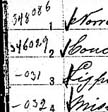
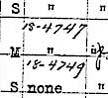
Numbers like those above are occasionally found in the left margin, especially on lists of ships from England. The numbers can have as few as 2 or 3 digits, and as many as 6 or 7 digits. These are "contract ticket" numbers issued by the steamship companies when contracting with the immigrant for their passage. The number may or may not have appeared on the immigrant's actual ticket or receipt. The steamship lines used the number as a personal identifier, and recording the number allowed the companies to match the manifest record with other business records. The numbers bear no relation to any other United States records. However, they may be useful in matching a U.S. passenger arrival record with a British departure record (British "outbound lists").

Lists from the 1890's or even the very early 1900's may have been printed by the steamship line with a "Contract Ticket" number column. This has been seen on passenger lists of the American Line from England in the mid-1890's. The presence of such a column demonstrates the importance of the information to the steamship company, and helps explain why it might be annotated at left on a list without a "Contract Ticket" column.

In some rare cases, typically on earlier lists prior to addition of the "Head Tax" column, a solitary number will appear to the left of a passenger's name. These lonely numbers are usually Head Tax receipt numbers. Notation of the receipt number may indicate either that the immigrant requested a receipt, disputed his/her requirement to pay the tax, or was only passing through the U.S. in transit (in which case the Head Tax deposit would be refunded upon their departure).

Not Shipped, N.O.B. or Did Not Sail

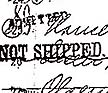
Often passengers booked to sail on a given ship did not depart. Perhaps they missed the ship, or changed their travel plans, or became ill and health officials prevented them from boarding the ship. Whatever the case, in some instances the change or decision occurred so late there was no time to amend the passenger list. Their names and passenger information remain on lists for ships upon which they never arrived.

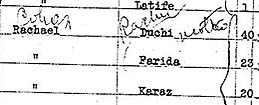
To indicate the record is meaningless, steamship company employees would mark the record in one of several ways. The most common was to "line out" the entire record with dark grease pencil or ink. Some of the lines are straight across and can be difficult to differentiate from scratches on the microfilm. Others are deliberately "wavy."

Some records remain without a line, but are noted in the left margin as "N.O.B." (Not On Board), "did not sail," or, like the stamp above, "Not Shipped." It was important for the steamship company to make clear who was and was not on board the ship when it arrived in the United States. The company was responsible for paying the Head Tax on each immigrant landed, and government officials calculated the company's monthly bill using the manifest lists. The passenger booked below "cancelled."

Note well that some of those names "lined out" were on board, but are officially recorded on another page of the passenger list. The example below includes two crossed-off names because they were "Not on Board," but one name is lined-out (line 21) because he/she is a "2nd class passenger." The official record of that person is, then, on the list of second class passengers.

Letters (including "X," "D," "S.I.," "B.S.I.,") or the Word "Held"

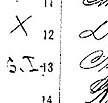
Extremely common are letters and stamps in the left margin relating to an immigrant's detention or their being held for a Board of Special Inquiry hearing. The general rule is that some notation was made at left to indicate the immigrant was held for some reason. One cannot determine the reason by looking at the annotation, and unless it was subsequently stamped "Admitted" or "Deported," one cannot determine the outcome.

In practice, variation can be found between the records of different ports. For example, the annotation "D" on a New York list means the immigrant was temporarily detained. But on a Philadelphia list, "D" can indicate either that the immigrant was temporarily detained or that he/she was held for a Board of Special Inquiry. The letters "X," "D," and the word "Held" can mean either that the immigrant went to temporary detention or had a Special Inquiry hearing. The more specific "S.I." and "B.S.I." indicate the immigrant was held for a hearing.
Unfortunately, for many passenger lists there is no additional information on the immigrant's fate. To date, additional records are known to survive for only two ports, and only for certain years. These ports are New York and Philadelphia.

Beginning in 1903, the Immigration Service at New York began filing Records of Detained Aliens and Records of Aliens Held for Special Inquiry at the end of each passenger list. Whenever a researcher finds an annotation in the left margin suggesting the immigrant was detained or held for a hearing, he or she should turn to the end of the passenger list and check these appended records to see if they contain further information.

Philadelphia records of detained immigrants (including those held for hearings) are extensive. They date from 1882 but only extend to ca. 1909. Some, dating from 1893 to 1909, are on microfilm as National Archives publication M1500. The majority remain in hard copy at the Regional Archives in Philadelphia. Anyone finding a detention annotation on a Philadelphia passenger list from this era should seriously consider investigating the Philadelphia detention records. And for Jewish immigrants, they might also consider the HIAS records in the Jewish Archives at Philadelphia's Balch Institute for Ethnic Studies.

MARKINGS IN THE MANIFEST’S NAME COLUMN

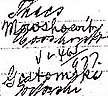
One would assume any annotations in the name column would concern the immigrants' names, and many do. In some cases the name might have been clarified or corrected by a steamship company employee or an Immigrant Inspector.

Many of the notations found in the name column relate not to the name directly but to later record checks, usually in response to an inquiry by the immigrant himself (or herself). Officials annotated almost anything in the name column, probably because it usually provided some empty space where information could be added.
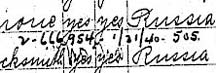
Letters "V/L" Followed by Numbers Over Numbers, Sometimes With a Date

Prior to 1924, there were no "Reentry Permits." This meant that immigrants living in the United States, who wanted to travel abroad, had no assurance they would be readmitted to the U.S. upon return. Many of them would contact the Immigration Service prior to travel and ask for some paper, or pass, to guarantee their reentry. A practice developed, especially at Ellis Island, to issue such immigrants a letter from the Port Commissioner documenting the immigrant's previous admission for permanent residence. The letter was not a guarantee, but greatly facilitated the immigrant's travel.

When the clerk verified (checked) the original passenger list in these cases, he or she would annotate the list to show the activity. The letters "V/L" or "V L" stand for Verification of Landing. The numbers refer to a New York (usually) file number wherein records of all these transactions were filed. The file did not relate to the individual. Rather, it contained stacks of incoming and outgoing letters on verification of landing matters. The files no longer survive. The annotations can be helpful, though, in that they suggest the immigrant was planning a trip abroad and may appear again on a later passenger list.

It may be that some of these verifications were performed for reasons other than reentry letters. For example, any other instance where an immigrant requested proof that he or she had been legally admitted to the United States. And there are occasions when one will find the "V/L" annotation format dated later than 1924. To see common references to Reentry Permits after July 1924, see below, and see the page on Visa annotations.

Letter "P" Or Word "Permit" With Numbers

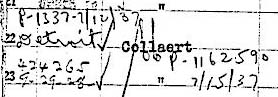
After July 1, 1924, immigrants in the United States who wished to travel abroad could apply for and obtain a Reentry Permit. The process involved filing an application, submitting a fee, and waiting for the permit to arrive prior to departure. The application required the immigrant to name their original port, date, and ship of arrival so the record could be checked and verified. During the verification, a clerk would annotate the original record with the letter "P" or the entire word "permit," followed by the application number. The annotations can be helpful in that they suggest the immigrant was planning a trip abroad and may appear again on a later passenger list. To see the Reentry Permit noted on the return trip passenger list, see the page
 on Visa annotations.

Both examples above and below show annotations including the word "Detroit," indicating the applications were filed in Detroit, Michigan, the INS office serving immigrant's current residence.

Clarified Or Corrected Names

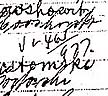
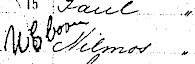
The if, when, and how of immigrant name-changing on ship passenger lists is a matter of unending controversy. But there were simple rules. Many names were clarified as in the two examples shown here. This clarification may have been performed by a steamship company clerk prior to departure, by the ship's purser during the voyage, or by an Immigrant Inspector during the inspection process. Note the alternate names or spellings are written above or beside the original name, in a manner that would no doubt confound anyone wanting to transcribe the list.

In other instances one will find a name deliberately crossed out (just the name, not across the entire page) and another name or alternate spelling entered. In these cases the name has been officially corrected according to standard bureaucratic procedure. Immigrants who arrived after June 29, 1906, often later encountered problems naturalizing because their immigration record name did not match their true name, and their immigration record name had to appear on the Petition for Naturalization. They could, if they desired, apply for a correction of the passenger list record. In addition to filing a form (of course), they submitted evidence that they and the immigrant on the passenger list were in fact one and the same person. When the request was approved, a government clerk was authorized to officially correct the record. He/she would cross out the old name and write in the new. In rare cases one will also find dates or file number references included in this annotation.

Correspondence Or Record Checks With Other Agencies Or Governments

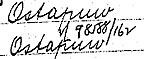
Among the most perplexing annotations are references to various record checks and correspondence lacking enough information for modern researchers to decipher their meaning. That said, familiarity with immigration records and procedure can often provide likely explanations or possibilities for further research. The example above includes an Ellis Island correspondence file number, "98588/162." Ellis Island files generally begin with "98" or "99." What was the subject of the correspondence? We may never know.

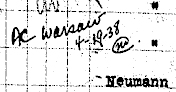
Another example reads "AC Warsaw 4-19-38" with what looks like the initial of whoever verified the record. "AC Warsaw" is almost certainly a reference to the United States (American) Consul in Warsaw, Poland. The U.S. Foreign Service, though the Department of State, often requested record checks from the Immigration Service in the cases of Americans in distress abroad, of immigrants stranded abroad while on a visit to the Old Country, or in connection with visa applications beginning in the early 1920's. The annotation at right indicates that in 1938 the U.S. Embassy in Warsaw had some interest in the immigrant listed. It could be the immigrant was in Warsaw, or perhaps one of the immigrant's relatives applied for a visa in Warsaw, and named the immigrant as his sponsor.

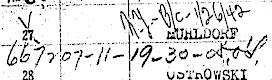
This annotation is also believed to relate to a passport or visa application to the Department of State. We know that by 1930 the State Department was active processing visa applications for relatives, and issuing passports to naturalized U.S. citizens. The annotation seems to list an application number, then a date (November 19, 1930), then the reference "D.O.S." On the other hand, the numbers may NOT relate to an application or a date, and the initials may be those of the verifier. We often must make our best guess based on understanding of immigration procedure of the time. In the same vein, the annotation on the line above our example seems to refer to correspondence between the New York (NY) immigration office and the Bureau (B/C, bureau correspondence) dated January 26, 1942.

MARKINGS ON THE MANIFEST’S OCCUPATION COLUMNREFERENCES TO OTHER PAGES OR LISTS

The most obvious markings in the occupation column relate directly to an occupation, and either correct or clarify the immigrant's trade. But the most perplexing annotations in that column have nothing to do with any occupation. Rather, they are number, letter, and date codes relating to later naturalization activity. They can be recognized by their being written--or the annotation beginning--in the occupation column, and by their adherence to a common format or style.

Numbers, Dates, Cryptic letters & Words


#1
In 1926, the occupation column was set aside for annotations relating to the verification of immigration records for naturalization purposes. Since 1906, no immigrant who arrived after June 29, 1906, could naturalize until the government located their immigration record. Thus since 1906, after an immigrant filed a Declaration of Intention or a Petition for Naturalization in a naturalization court, the Bureau of Naturalization was called upon to provide a certification of the immigrant's arrival record. The certification, called a "Certificate of Arrival," was sent to the courthouse to satisfy the naturalization requirement that everyone who arrived since June 29, 1906 had to have a legal immigration record if they wanted to become a U.S. citizen. 

#2
 From 1906 to 1926 this activity took place without any notation made on the passenger list being certified. But in 1926 verification clerks began to record the verification (record check) and certification activity on each passenger list record. This change came about in response to a terrible scandal about fraudulent naturalizations. By noting that a given immigration record had been used to support an individual naturalization, the annotation served in future to prevent anyone else from using that record for another naturalization. While the annotations may be found on any passenger list, before or after 1926, they will all relate to naturalization activity occurring in 1926 or later (see below). Remember also that the passenger lists were microfilmed in 1942/43, so records of immigrants who arrived earlier but did not begin the naturalization process until after 1942 could not be annotated.


#3
#4
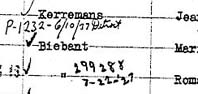
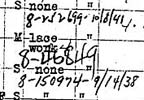
All the verification for naturalization annotations follow a prescribed format containing one or more of the following elements: District number where the application was filed, application number, date of verification, and document issued. The table below identifies each element for the examples illustrating this page. Note that not all annotations of this type will contain every element. Examples 2, 4, and 5 do not indicate what document was issued, and examples 3 and 5 contain no date.
Example 5 suggests two family members who immigrated together also later applied for naturalization together. They applied in the same District (#18), and their application numbers are almost consecutive. Example 6, below, shows a record with two dates annotated: One for the original verification in 1935, and another from a "Recheck" in 1937.

#5
At times, Verification Clerks could not be sure the record found really did relate to the person who claimed that arrival record on their naturalization application. If there were enough significant differences, the clerk could not certify the arrival record. Minor differences were routine--ages one or two years off, height off by a few inches, or Americanized names (Jacob for Yankel, for example). But many years difference in age/date of birth, differing eye color, or place of birth, prohibited certification without further explanation. In those cases, the clerk issued a record (Form 505, or 404), but issued no Certificate of Arrival. Hence the frequent annotation "No C/A."
#6
Verification of Arrivals Prior to June 30, 1906


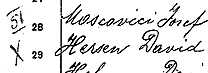
As noted above, there was no Certificate of Arrival requirement for immigrants who arrived prior to June 30, 1906. Nevertheless, one will see occational naturalization verification activity associated with pre-1906 lists. The example below is from a 1903 passenger list, and displays two characteristics of verifications for pre-1906 arrivals. One is the "X" between the district number and the application number. The "X" means the applicant did not have to pay the Certificate of Arrival fee, and in this case was exempt because he arrived before 1906. The other is the reference to issuance of a "C.L ." (or C/L), which is a Certificate of Landing. A Certificate of Landing served the same purpose as a Certificate of Arrival in the naturalization process, but since the latter were only issued to those who arrived after 1906, they needed another name for certifications from pre-1906 records.


Interpreting the Verification for Naturalization Annotations

This step is not so simple as it may seem. The presence of a verification annotation in the occupation column indicates the immigrant initiated naturalization activity between 1926 and 1942/43. In cases where no date is shown, there is no way to determine when this activity occurred. The application number is useless in finding naturalization records. Only the District key number is of limited help, in that one can usually use the number to determine a general location where the immigrant was living when he/she filed their application.


Unfortunately, the Naturalization Service would occasionally re-number all the districts. This means that Chicago might be in District #6 in 1927, but in District #11 in 1931. Chicago did not become District #9 until the early 1940's. Thus it is extremely important to know the date of the annotation if one is to convert the District number into a geographic region of the country.


The tables below show the Districts by number during different time periods. If you don't have a date, or if your date may fall on either side of a dividing line, check both or all tables for the locations. Some knowledge of the immigrant's history should allow you to guess which table fits your annotation.


ANNOTATIONS REGARDING NATIONALITY & CITIZENSHIP

Annotated references to a passenger's nationality are usually, and usually should be, in the nationality column. In fact these references might be found anywhere on the list page, and are frequently found in the name column or the left margin (as were two of the examples on this page).

References to a passengers citizenship, either by birth or naturalization, were added upon arrival by the Immigrant Inspector. The fact of the person's citizenship is the Inspector's explanation of why the individual could be admitted without further questioning.

USB or US Born

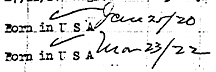
Persons born in the United States are US citizens (unless they later expatriated themselves), and are entitled to admission to their own country. Thus the annotation "US Born" has great meaning to the passenger's admission under immigration law, and it is not surprising the fact of their citizenship would be noted. The "USB" annotation is often seen in the case of children returning home after a visit abroad with their foreign-born parents. These children, though citizens, were frequently listed on a "List of Alien Passengers" so they might be listed with their parents. The fact of their US birth is noted to explain why the children were not inspected in the same manner as non-citizens.


The same principle explains the example at right, taken from the "Visa" columns of a late 1924 passenger list. Those columns normally contain information about when, where, and what sort of visa was issued to the immigant. U.S. citizens did not need such documents, so their absence was explained by giving the birthdates of the children. These may have been taken from birth certificates carried by the parents as their children's travel papers. Some similar annotations have been seen to provide the specific birth certificate number.
 
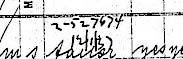
USC, Nat, Natz, Naturalized or Naturalization Certificate Number

Though the example shown above right is from the name column, references to a passenger's naturalized status are usually found farther right, in the nationality column or in the blank space left in the columns under heading concerning health condition, height, weight, and eye color. This example indicates the passenger was issued naturalization certificate #383553. The number "2271" means the naturalization occurred in the U.S. District Court for the Eastern District of New York in Brooklyn. The date may be the
date of naturalization, but could be the date of a verification. The six-digit number at left remains a mystery, and may have been added years later.

The images above come from the passenger list record of a naturalized citizen returning home. The annotated "USC" appears in the nationality column. Farther right, in empty space, is the reference to his naturalization in the Superior Court at Cedar Rapids, Iowa, on October 31, 1911. In the case of both examples shown, the immigrant carried evidence of his naturalization (probably his naturalization certificate) on his journey, and the Immigrant Inspector took the information directly from that document. Unfortunately, on a busy day, the Inspector might note the "USC" status and fail to record the details of the passenger's naturalization.

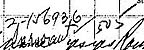
Yet another annotation capturing information about a naturalization is found in the name column, above the name. This naturalization took place in the US District Court in Chicago (750), and Walter Kochman was issued certificate number 2367921.


Occasionally one will find annotations that refer to other passenger lists. The other list may be another page of the same ship's list, or it may refer to a different ship arrival, on a different date, or at another port. The cross-references link passengers who are related somehow but not listed together, or links the various records of one passenger who arrived more than once. Cross-references are usually, but not always, found in the Name column.

References to Other Pages Of the Same Ship's List
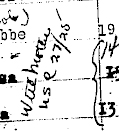
The annotation at right indicates that two teenage steerage passengers are actually traveling with their mother. But their mother is a U.S. citizen, so she is listed on another page listing U.S. citizens. They are "with mother" on list of "USC"itizens, either page 27, line 25, or on lines 25 through 27.

Movements between Steerage, First and Second Class Cabin

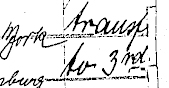
 Some immigrants changed their class of ticket either just before departure or once underway, much like airline passengers today might "upgrade" to first class just before the flight departs. If the change came at the last minute or once the ship sailed, it was too late to be recorded in the final draft of the passenger list. As a result, pursers annotated lists to show the change. The example at right, found in the name column, indicates the passenger "transferred to Third Class." The example below explains that the passenger's Steerage list record is lined out because he transferred to Second Class.


Often, when a passenger moved between classes in this manner, the result is two records of the same person on the same ship--one record on the list as originally booked, and another on the list of the class in which the immigrant arrived. The same could happen when an immigrant for some reason "missed the boat" upon which he was booked and took the next ship instead. In those cases, he may appear to arrive twice, on ships arriving one after each other. If last minute changes could cause one immigrant to be listed twice, it is reasonable to assume the same situation might also cause an immigrant to fall through the cracks and not be listed at all.

References to Other Ship Lists

Many immigrants arrived in the United States several times, and consequently have more than one passenger list record. Sometimes these additional records are only suggested by Verification of Landing annotations found in the Left Margin. But at other times, the linkage between two records of the same person are unmistakable. One of the most striking differences between an immigrant's original arrival and a later entry is the "Americanization" of their names between arrivals.

The examples below relate to three men listed together on the SS Pocahontas, which arrived in New York in mid-June, 1920. All three of the men were returning on that voyage, each having been previously admitted in earlier years. And all three have their records linked by references to earlier passenger lists. It appears all three had their records cross-referenced as a result of naturalization activity.
 

Note that since these annotations were made years before microfilming of the records, they make no mention of National Archives or LDS microfilm roll numbers. Rather, they rely on the volume, page, and line numbers. The page numbers correspond to "stamped" page numbers on the passenger lists that run consecutively through a volume (as opposed to other numbers original to the ship list).

MARKINGS IN OTHER MANIFEST COLUMN


In the Head Tax Column

Until 1952, there was a "Head Tax" on each immigrant entering the United States. For most immigrants, the tax was included in the price of their steamship ticket and paid by the steamship company. The same was true for passengers who came by railroad or ferry across the Northern and Southern Borders. Those immigrants who came "under their own steam" had to pay at the door.
Not everyone had to pay the Head Tax. Children under 16 were exempt, as were returning residents, citizens/natives of Canada, Mexico, and most Caribbean islands. Also exempt were "Non-Immigrants," that is, people who were not coming to live in the U.S. permanently. In this category were visitors, tourists, and people traveling through U.S. territory in transit to another country. Many nonimmigrants had to pay the Head Tax as a deposit to guarantee they would leave as promised. Those "transits" who paid a Head Tax deposit got a receipt and had the fee refunded when they departed.

Many returning residents disputed their need to pay the Head Tax, claiming they already paid it upon their first arrival. They usually paid the tax, got a receipt, went to their home in the U.S., then pursued their refund by mail.

In the Can Read and Write Column

The Immigration Act of 1917 first required that immigrants coming to live in the U.S. permanently be able to read and write in their native language. Thus passenger lists after 1917 include a column asking whether the passenger can read and/or write, and in what language. Whenever an Immigrant Inspector suspected that an applicant for permanent admission was illiterate, he could send them for a literacy (reading) test.

The government initially tested the immigrants by having them read selected passages from the Bible, but it became clear this system could be controversial. So the Immigration Service soon developed a rather complicated system to perform the testing. First, each known language was issued a number. Then, a number of phrases and passages in each language were printed on slips of paper (one phrase per slip), and each phrase received a serial number. So each slip had one number for the language, and another for the phrase (i.e., #-####).

A second set of slips were printed in English, and numbered with the exact correponding numbers. The phrases usually contained simple instructions, such as "Get up, open the door, and return to your chair," or "Shake the hand of the person next to you." The literacy test involved first determining what language the immigrant spoke/read, locating a slip for that language, and giving the immigrant the test language slip and the testing official the corresponding English language slip. By reading the corresponding instructions in English and observing the immigrant's actions, even an Inspector who spoke only English could discern whether the person before him could read.

The passenger manifest would later be annotated with the number of the test slip. The notes indicated both that the immigrant was tested and exactly which test was given. A test slip number by itself usually indicates the immigrant passed. If he/she failed, the annotation often also includes the words "cannot read." If their illiteracy became grounds for exclusion (i.e., the reason to send them back), it should appear on a List of Aliens Held for Special Inquiry.

Hospital Stamps or Medical Annotations

Some records of immigrants who were held for real or suspected ailments bear a stamp reading "IN HOSPITAL." Many also have stamps indicating the end of their hospital stay, as either "discharged," "died in hospital," or "deported." If an immigrant was hospitalized, beginning in 1903 at New York the immigrant should also appear on a List of Aliens Detained or a List of Aliens Held for Special Inquiry. If they were hospitalized at Philadelphia ca. 1882 to ca. 1902, there may be additional records at the National Archives in Philadelphia. There are no known additional records for other ports.

Any immigrant whom the Public Health Service doctors thought might be sick, mentally ill, or otherwise unable to take care of themselves might be issued a Medical Certificate (click here to see a 1906 Medical Certificate). Those immigrants certified then went for a full examination by medical staff. They may not have been hospitalized, but many ship lists bear annotations noting Medical certificates, like those illustrated below, both certifying "senility":


Note the examples above and below both contain some language saying the doctor was of the opinion the condition would affect the immigrant's ability to earn a living (that is, a Likely Public Charge, or LPC).

Non-Immigrant Stamps

The question of how much money an immigrant had in his possession is related to his or her ability to support themselves in the United States and not become a Likely Public Charge (LPC). They needed enough money to pay for transportation, food, and lodging until they found a job, a place to live, etc. The amount needed would differ for different immigrants. Those coming to live with family members needed less cash on hand than those with only temporary lodging arranged. And those with scarce or marketable skills needed less money than common laborers, especially at times of high unemployment in the United States.
Immigrants were frequently less than truthful about the amont of money in their possession. Some claimed to have more money than they had, thinking the higher number would improve their chance of admission to the United States. Others claimed far less than was true, fearing their life's savings would be stolen by other passengers, or taken from them by corrupt border guards encountered on their journey.
Immigrant Inspectors often corrected the amount during immigrant inspection. Small variations are expected, explained by the fact that some funds might be spent while aboard the ship. Large differences are usually explained by the fact that many immigrants hid the fact that they carried large amounts of money until they arrived in America.

Discharged at Pier, Discharged at Dock

Some passenger lists contain stamps or annotations indicating a passenger was "discharged" at the pier or dock. First and second class passengers were generally inspected on board the ship and allowed to proceed while steerage immigrants lined up to board barges or ferries to Ellis Island. United States citizens listed on alien pages often display a "US Citizen discharged at pier" stamp. The example at right is from the record of a 26 year-old student "d[is]c[harge]d at dock" by Inspector Biglin. Whenever a passenger is so annotated, it means they did not proceed with others on that page toward extended immigrant inspection.

GLOSSARY OF ACRONYMS & ABBREVIATIONS

Many acronyms and abbreviations are found on the manifests and are used on this website. Below is a listing of the most commonly used acronyms and abbreviations, what they stand for and what page of this site further information can be found on.

Acronym/Abbreviation ... Stands for ... Found here...

404 ... Form 404 - Arrival Information ... Occupation Column
505 ... Form 505 - Arrival Information ... Occupation Column
ACL ... Alien Contract Labor ... Special Inquiry
B/C ... Bureau Correspondence ... Name Column
B-i-l ... Brother-in-law ... Record of Detained Aliens
B.S.I. ... Board of Special Inquiry ... Left Margin
C ... Certificate (usually) ... Nationality and Citizenship
C/A ... Certificate of Arrival ... Occupation Column
C.L. ... Certificate of Landing ... Occupation Column
CL ... Contract Labor ... Special Inquiry
D ... Detained ... Left Margin
Dcd. ... Discharged ... Other
Dep.-Excl. ... Deportable and Excludable ... Special Inquiry
D.O.S. ... Department of State ... Name Column
Husb ... Husband ... Record of Detained Aliens
LPC ... Likely Public Charge ... Special Inquiry or Other
Med Cert ... Medical Certificate ... Special Inquiry or Other
Nat or Natz ... Naturalized ... Nationality and Citizenship
N.O.B. ... Not On Board ... Left Margin
P ... Permit ... Name Column
Rech ... Recheck ... Occupation Column
R.R. ... Railroad ... Record of Detained Aliens
S.I. ... Special Inquiry ... Left Margin
Tel $ ... Telegram sent for money ... Record of Detained Aliens
USB ... US Born ... Nationality and Citizenship
USC ... United States Citizen ... References to Other Pages or Lists
V/L ... Verification of Landing ... Name Column
X ... "Detained" ... Left Margin